War, Conflict & Life Insurance in UAE: Will Your Policy Still Pay?
With recent tensions in the Gulf, many people are asking:
👉 “If something happens during a conflict, will my life insurance actually pay?”
The quick answer is
👉 Some life insurance policies will pay. Some will not.
The difference comes down to one thing:
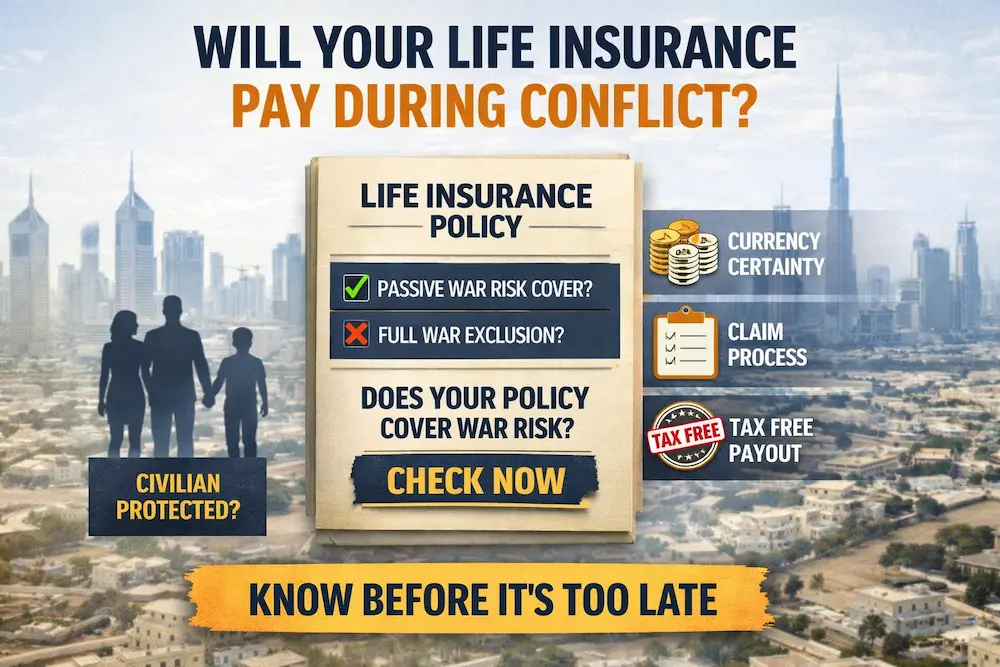
👉 Whether your policy includes passive war risk cover and its scope.
What Is Passive War Risk, and Why It Matters
Passive war risk means:
- You are not actively involved in conflict
- You are a by standing civilian affected by events
If your policy includes this:
👉 There is a strong likelihood that a valid claim will be paid
If it doesn’t:
👉 The claim may be rejected, even though it feels unfair
This Is Where Most People Get It Wrong
They assume:
👉 “I have life insurance, so I’m covered.”
That’s not always true.
Because:
- Many policies still have full war exclusions
- Some have limited definitions
- Others include passive cover, but with conditions
👉 The gap between policies is real
First Step: Check Your Policy (Don’t Guess)
Before worrying — or assuming — take a few minutes to check:
✅ Does your policy include passive war risk?
✅ Does it clearly define civilian exposure?
✅ Does it cover disability as well as death?
If you’re unsure, that itself is a red flag.
Life Insurance Should Work When It Matters Most
Life insurance companies should test you when you buy the policy, not your family’s patience when they make a claim.
Because having coverage is one thing.
👉 Getting the money smoothly and without stress is what actually matters.
The UAE Advantage:
Once you know you are covered, the next question is:
👉 “How easy will it be for my family to receive the payout?”
This is where UAE-based life insurance has a practical edge.
1. Claims Are Handled Locally
- Insurers operate within the UAE
- Documentation is familiar
- No cross-border delays
👉 This reduces friction significantly
2. Simpler for Families
At claim stage:
- Families are under stress
- They don’t need complexity
With UAE policies:
- Local support teams guide the process
- Faster communication
- Fewer layers involved
3. Strong Regulatory Oversight
Insurance in the UAE is regulated by the Central Bank.
👉 This ensures:
- Defined claims processes
- Accountability
- Consumer protection
Currency Advantage: Clarity When It Matters Most
Policies are typically structured in:
- AED
- USD
- GBP
- EUR
👉 And the payout is made in the same currency or AED
This means:
- No forced conversions
- No exchange rate surprises
- No uncertainty
Tax Advantage: What Your Family Receives Is Theirs
The UAE has:
- No income tax
- No inheritance tax
👉 So the payout is received in full, without any tax deducted at source.
A Balanced View
Features like:
- Passive war risk
- Critical illness
- Worldwide cover
👉 Are important
But they are not consistent across all policies
That’s the reality.
The Real Difference
It’s not just about:
- Whether something is covered
It’s about:
- How clearly it is defined
- Whether the claim will be accepted
- How smoothly the payout happens
Final Thought
If your policy includes passive war risk cover,
you may already be protected.
If it doesn’t,
you may be exposed without realizing it.
And in both cases, one question remains:
👉 Will the claim process be simple when your family needs it most?
Because life insurance should test your health at the outset; not your family’s patience at the time of claim.
If you’re unsure whether your policy includes passive war risk; or how it will perform at claim stage. It is worth reviewing it properly.