How to Get Out of Debt in the UAE – The Rocket Plan to Break Free
Debt is the sweet poison that keeps you trapped, until it’s almost too late.
At first it feels like freedom. Like richness. It makes you buy things you wouldn’t have otherwise; branded clothes, gizmos, weekend brunches, a better car, a holiday you couldn’t quite afford.
Then the interest creeps in. Quietly at first. Eating into your lifestyle. Then your savings. Then your basics. Until one day, you can’t cover the month without borrowing again.
That’s when people start asking: how to get out of debt?
By then, it feels like quicksand — the harder you struggle without a plan, the deeper you sink. Or like gravity: invisible but relentless, pulling you back no matter how hard you try to move forward.
Why Debt’s Pull Is So Strong in the UAE
It’s not just bad habits. It’s a system designed to keep you in.
Banks and retailers make it easy to spend more than you earn. Generous credit limits. Personal loans on tap. “Interest-free” installment offers at every checkout. They make you feel richer than you actually are.
For new expats, lifestyle upgrades happen fast; usually without a budget or a plan. A few impulsive purchases. One unexpected expense. A card swiped “just for now.” That’s all it takes to start falling.
And the numbers show how strong the pull is:
- The average UAE resident with active credit cards carries around AED 42,000 in debt.
- Nearly half say their income isn’t enough to cover repayments.
- 60% spend a quarter or more of their salary servicing debt (Fast Company Middle East, 2025).
- UAE credit cards charge 3.25%–3.85% per month — 40–46% per year, among the highest in the world.
- UAE household debt reached USD 149 billion in September 2025, about 24% of GDP (CEIC Data, 2025).
- Missing 3 consecutive payments (or 6 non-consecutive) triggers legal default — leading to travel bans and frozen accounts (Lotus Advisory UAE, 2026).
Minimum payments are like tiny thrusters — they burn your money but barely move you upward.
The good news? Every trap has a way out.
To break free, you need concentrated thrust early on; cut expenses, boost income, and direct everything you can toward high-priority debt. Once you’re in financial orbit, the same energy that was barely keeping you afloat now builds wealth.
Here are the 7 steps to launch your escape.
Step 1 – Know Exactly What You Owe
Every rocket launch starts with calculations.
You can’t escape gravity until you know your mass and trajectory — and in debt terms, that means knowing exactly what you owe and how much you are paying as interest.
List all debts — credit cards, loans, car finance, and any personal borrowings. For each, record:
Balance
Interest rate
- Interest paid
Minimum monthly payment
Due date
Pro tip: Use this This free debt payoff calculator in AED for UAE Residents
Step 2 – Snowball vs Avalanche method – Pick a Strategy
Two methods. Both work.
| Details | Snowball | Avalanche |
|---|---|---|
| Order | Smallest balance first | Highest interest first |
| Wins | Fast, emotional | Slow, mathematical |
| Saves more? | No | Yes |
Avalanche is the math. Pay the highest-interest debt first. In the UAE that’s almost always a credit card at 40–46%.
Snowball is the psychology. Pay the smallest balance first to build momentum. Research backs this up — Gal & McShane (2012) at the Kellogg School found that closing accounts predicts debt elimination, regardless of size (JMR). Small wins compound.
The best method is the one you’ll actually follow.
If you have 1–2 cards, use Avalanche. If you have 5 debts and feel paralysed, use Snowball. Don’t optimise for math at the cost of momentum.
Pro Tip: Just like a rocket needs sustained thrust to escape Earth’s gravity, your first few months of intense repayment will determine how quickly you break free.
Step 3: Stop Adding Weight
You can’t lift off while loading cargo.
- Call the bank. Lower your credit card limit. – (The National News, 2022).
- Stop using cards for anything discretionary.
- Delete saved cards from Amazon, Noon, Talabat, Careem.
- Unsubscribe from promo emails.
- Avoid BNPL — “interest-free” isn’t free. It fragments your cashflow and hides the real burden.
Spending today is become friction free. Add friction back.
Step 4: Find the Cash
Earning more is hard. Spending less is a decision you make today.
Audit:
- DEWA bill — AC at 22/23°C, not 18°C
- Dining out — usually the biggest leak
- Subscriptions — Netflix, Starzplay, gym, ClassPass, every app
- Salik, fuel, transport
- School drops, deliveries, conveniences
- Online Shopping and Weekend Mall visits
Most clients find AED 1,500–3,000 a month the first time they look honestly.
Use the Expat Advantage Budget (EAB) to find money.
Step 5 – Negotiate and Consolidate
Lighten the load before lift-off.
Ask your bank for a lower interest rate or to waive late fees (Khaleej Times, 2023).
Consider a debt consolidation loan to combine multiple high-interest debts into one lower-interest payment — but only if you commit to not adding new debt (Gulf News, 2023).
One warning: consolidation only works if you don’t refill the cards. Otherwise you’ve doubled your debt and called it a strategy.
Step 6: Build the Buffer
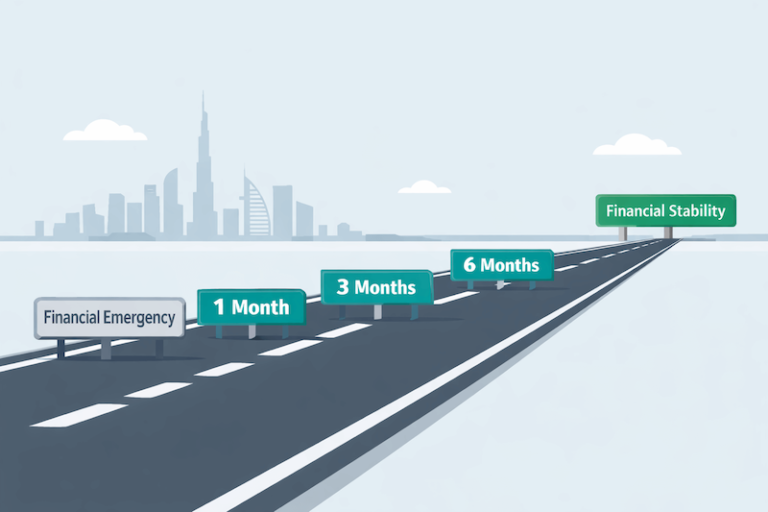
Once the worst debt is dead, build stabilisers. 3–6 months of essential expenses as emergency savings.
This is the single reason people relapse. Car breaks. Visa renews. Someone gets sick. Without a buffer, you’re back on the card.
Park it somewhere boring — a high-yield UAE savings account or money market fund. Not your current account. Not stocks. Cash you can reach in a day, but not impulsively.
Step 7: Flip the Direction
Debt cleared. Buffer built. Now redirect.
The same monthly payment that was killing you now builds wealth. Same dirhams. Opposite direction.
- Long-term investment portfolios
- Retirement — most UAE expats need 25× annual expenses
- Passive income — dividends, rental, structured products
The goal was never debt freedom. The goal is to wake up one day with assets earning more than your salary.
That’s what I help clients do at GAiM Plan.
👉 Read next: FIRE Retirement for UAE Expats | Whole Life Insurance Explained
Frequently Asked Questions
How much debt does the average UAE resident have?
Roughly AED 42,000 in credit card debt for those carrying cards (Lin International, 2025). Total UAE household debt: USD 149 billion, about 24% of GDP (CEIC, 2025).
What’s the best way to pay off credit card debt in Dubai?
Avalanche — pay the highest-APR card first. UAE cards charge 40–46% annually. Killing the most expensive debt first saves the most money.
Snowball vs avalanche — which works better in the UAE?
Math says avalanche. Behaviour says snowball. Both work if you don’t stop. Pick the one you’ll stick with.
Can I consolidate debt in the UAE?
Yes. Personal loans at 6–15% replace credit cards at 40–46%. Most major UAE banks offer it. Balance transfer cards are an alternative.
What happens if I stop paying my credit card?
Three consecutive missed payments (or six non-consecutive) = legal default. Banks can demand full repayment, freeze accounts, file travel bans, or pursue you criminally on security cheques. Talk to the bank before you miss a payment, not after.
What is the Debt Burden Ratio (DBR)?
Your total monthly debt divided by gross income. UAE Central Bank caps it at 50% for individuals, 30% for pensioners (Circular No. 29 of 2011). Above 50%, you can’t take on more debt — even to consolidate.
How long does it take to get out of debt?
For AED 40,000–60,000 of card debt, 12–24 months with a real plan. Less if you consolidate. More if you don’t.
Is there a UAE debt relief program?
No formal consumer debt relief like in the US or UK. Options: direct bank negotiation, debt consolidation loans, licensed debt management firms. Avoid unlicensed agencies promising miracles.
Ready to Build Your Rocket Plan?
The hard part isn’t knowing what to do. The hard part is starting.
Most people who try alone restart three times before they finish. With a plan and someone watching, they finish once.
I help UAE expats build personalised debt-payoff plans and then move them into wealth building. Usually 18–24 months from start to assets.
👉 Book a free Debt Strategy Call — 30 minutes. No obligation.
Sources
- Fast Company Middle East (April 2025). Why are many people in the UAE falling into the debt trap? — https://fastcompanyme.com/impact/why-are-many-people-in-the-uae-falling-into-the-debt-trap/
- CEIC Data (Sept 2025). UAE Household Debt — https://www.ceicdata.com/en/indicator/united-arab-emirates/household-debt
- Lin International (July 2025). Credit Card Debt in the UAE — https://lininternational.net/credit-card-debt-in-the-uae-what-the-banks-dont-tell-you/
- Lin International (Feb 2026). How Credit Card Interest Is Calculated in the UAE — https://lininternational.net/how-credit-card-interest-is-calculated-in-the-uae-and-why-balances-grow-so-fast/
- Lotus Advisory UAE (2026). Settle Credit Card Debt in Dubai — https://lotusadvisoryuae.com/struggling-with-credit-card-debt-in-dubai-how-to-settle-legally-and-avoid-travel-bans-2026/
- UAE Central Bank Rulebook. Article 3: Important Ratios — https://rulebook.centralbank.ae/en/rulebook/article-3-important-ratios
- UAE Expert Hub (March 2026). Best Credit Cards in UAE — https://www.uaeexperthub.com/best-credit-cards-uae/
- HSBC UAE. Credit Card Charges — https://www.hsbc.ae/credit-cards/credit-card-charges-and-how-to-avoid-them/
- Gal, D. & McShane, B.B. (2012). Can Small Victories Help Win the War? Journal of Marketing Research, 49(4), 487–501 — https://doi.org/10.1509/jmr.11.0272
- Emirates NBD. How to Get Out of Debt — https://www.emiratesnbd.com/en/corporate-social-responsibility/financial-literacy/articles/how-to-get-out-of-debt
- Fidelity. Debt Snowball vs Avalanche — https://www.fidelity.com/learning-center/personal-finance/avalanche-snowball-debt